
Introduction
Whenever electricity travels from one piece of electrical equipment to another, the connection must be made safely and reliably.
That connection is rarely just a cable. It almost always requires a specialised high-voltage joint or termination.
From offshore wind farms and power stations to substations, battery energy storage systems (BESS) and industrial facilities, high-voltage jointing is an essential part of modern electrical infrastructure.
To understand where cable joints and terminations are needed, it helps to look at the four stages of the electrical power system.
1. Generation in High Voltage
What is generation?
Generation is where electricity is produced.
Examples include:
- Offshore wind farms
- Onshore wind farms
- Solar farms
- Hydroelectric plants
- Nuclear power stations
- Gas-fired power stations
- Battery Energy Storage Systems (BESS)
Where are cable terminations required?
Electricity cannot leave the generating asset until it has been connected to transformers or switchgear.
Typical applications include:
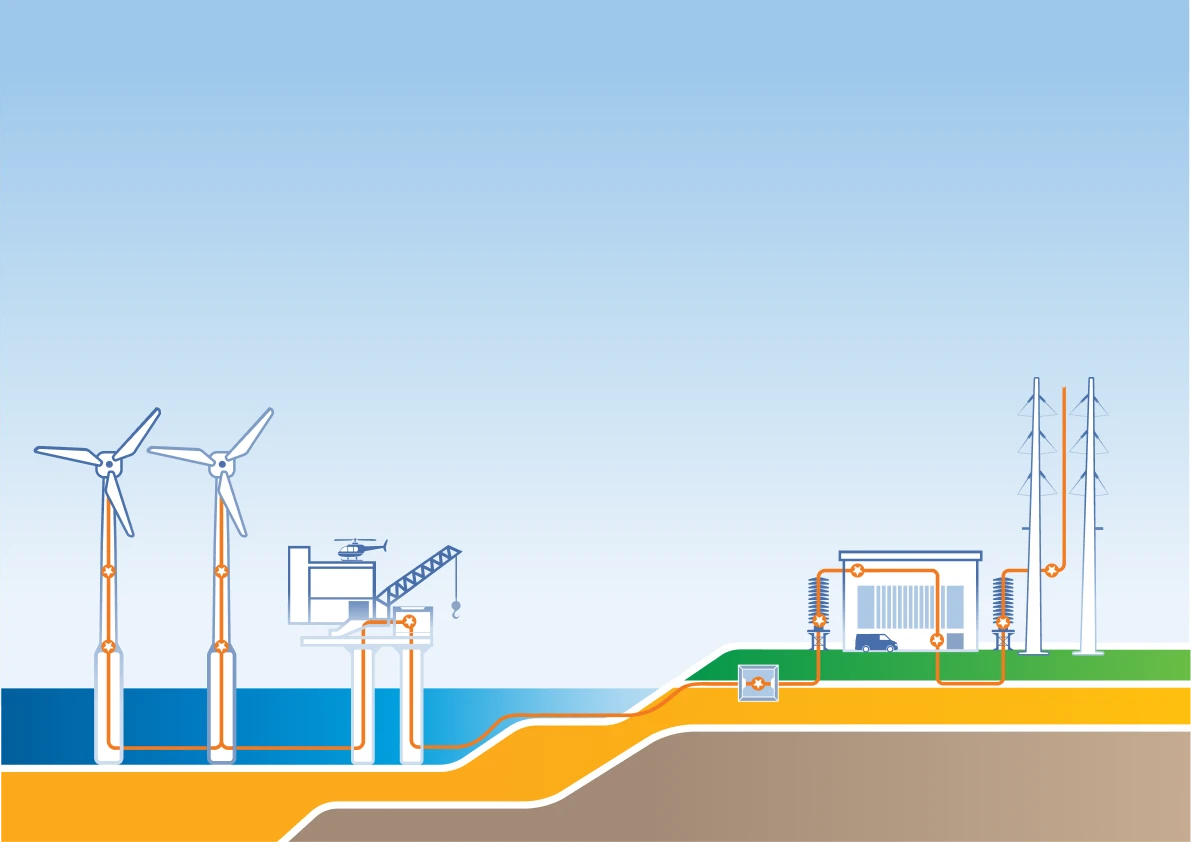
- Wind turbine terminations
- Transformer terminations
- Export cable terminations
- Generator connections
- Offshore array cable joints
2. Transmission
Transmission moves electricity over long distances using very high voltages.
Typical voltages include:
- 110 kV
- 132 kV
- 220 kV
- 275 kV
- 380/400 kV
- HVDC systems
Although overhead lines are highly visible, many transmission projects also rely on underground cable systems.
These cables require specialist joints and terminations wherever sections are connected or equipment is installed.
Typical applications:
- Underground cable joints
- GIS terminations
- Transformer connections
- Landfall joints
- HVDC converter station terminations
3. Distribution
Distribution networks deliver electricity from transmission substations to towns, businesses and industry.
This is currently one of the fastest-growing areas of electrical infrastructure because of electrification.
Examples include:
- New substations
- Battery storage projects
- Solar farms
- Wind farms
- EV charging infrastructure
- Industrial grid upgrades
Every one of these projects contains numerous high-voltage cable connections.
Typical applications:
- Ring Main Units (RMUs)
- Primary substations
- Secondary substations
- Switchgear
- Transformers
4. Utilisation
Electricity finally reaches the end user.
Large industrial consumers often receive electricity directly at medium or high voltage.
Examples include:
- Data centres
- Factories
- Airports
- Ports
- Steel plants
- Hydrogen production facilities
Cable terminations are required whenever electrical equipment is installed, upgraded or maintained
Why Are High-Voltage Cable Joints So Important?
Unlike low-voltage electrical systems, high-voltage cables cannot simply be connected together.
Each joint and termination must:
- Maintain electrical insulation
- Prevent partial discharge
- Control the electric field
- Keep moisture out
- Withstand mechanical stress
- Operate reliably for decades
Poor installation can result in failures that are extremely costly and difficult to repair.
Where Are High-Voltage Cable Joints Found?
| Power system stage | Typical assets | HV joints & terminations |
| Generation | Wind farms, power plants, BESS | Generator, transformer and export cable terminations |
| Transmission | Transmission substations, underground cables, HVDC | Cable joints, GIS, transformer terminations |
| Distribution | Primary substations, RMUs, solar farms | Switchgear and transformer terminations |
| Utilisation | Factories, data centres, ports | Incoming HV cable terminations |
Conclusion
High-voltage cable joints and terminations are found throughout the electrical grid—not just in one type of project.
From renewable energy generation to national transmission networks, regional distribution systems and industrial facilities, every stage depends on safe, reliable high-voltage connections.
As electrical infrastructure expands to support the global energy transition, the demand for specialist high-voltage jointing expertise continues to grow.