

An offshore wind farm is not built overnight. What began a decade ago as seabed surveys and environmental assessments culminates in years of high-stakes marine engineering. Construction burn rates frequently exceed €1 million to €2 million per day. Consequently, the pressure on time, safety, and precision is immense.
Despite the massive scale of turbine installation, the success of the entire project hinges on one final milestone. That milestone is the completion and sign-off of high-voltage (HV) cable termination and testing.
Until teams terminate, test, and certify the 66kV inter-array and 220kV+ export cables, gigawatts of green energy remain isolated at sea. However, once engineers sign that final test certificate, the project officially begins offshore wind energisation. The site transforms from a construction zone into a live power plant.
So, what actually happens in the days following HV testing sign-off? How fast do electrons generated far offshore reach heavy industry, data centres, electric fleets, and homes?
1. The Critical Milestone: HV Cable Termination & Testing Sign-Off
Before green power flows onto the mainland, the transmission backbone requires strict Quality Assurance and Quality Control (QA/QC) verification. Engineers must verify both the 66kV inter-array cables and the 220kV+ export cables.
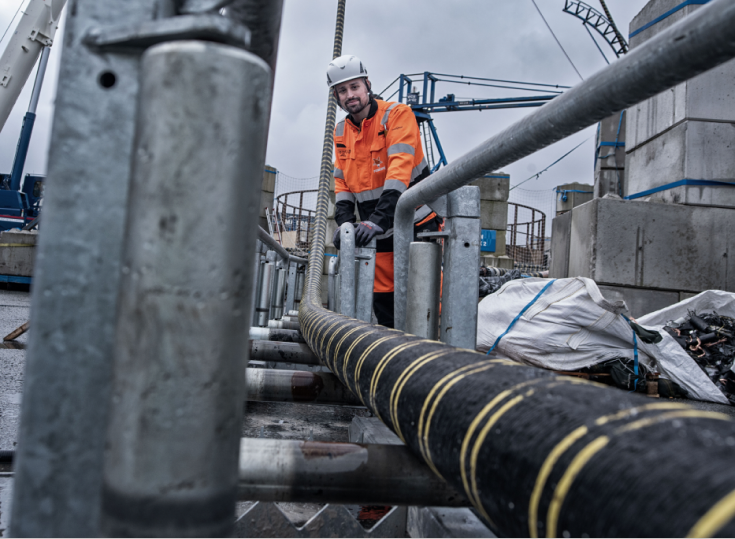
High-voltage termination demands extreme precision. Cables feature complex, layered assemblies with copper or aluminum conductors, insulation, metallic sheaths, and heavy armoring. Technicians must prepare, splice, and terminate these cables under strict clean-room conditions. In fact, a single drop of moisture or airborne particle can compromise dielectric integrity under severe electrical stress.
Therefore, to guarantee decades of fault-free operation prior to offshore wind energisation, testing teams perform a comprehensive battery of field diagnostics:
- Insulation Resistance & Sheath Integrity Testing: Technicians verify that the outer jacket and insulation remained intact during deployment.
- Damped AC (DAC) or Very Low Frequency (VLF) Testing: Engineers assess partial discharge (PD) activity. This confirms that joints and terminations will hold under operational stress.
2. The Final Countdown: The 3 to 10 Day Offshore Wind Energisation Sequence
Once the Transmission System Operator (TSO) and Independent Certifiers accept the test certificates, the project transitions into live operation. The offshore wind energisation phase typically takes 3 to 10 days. The site team executes this phase under a strict operational sequence:
[ Days 1–3: Safety Transfer ] ──► [ Days 3–5: Onshore Back-Feed ] ──► [ 24–48 Hours: Soak Test ]
- Handover & Operational Safety Transfer (Days 1–3): First, the team closes all construction permits. Control of electrical assets officially transfers to the High Voltage Operational Authority under strict System Safety Rules.
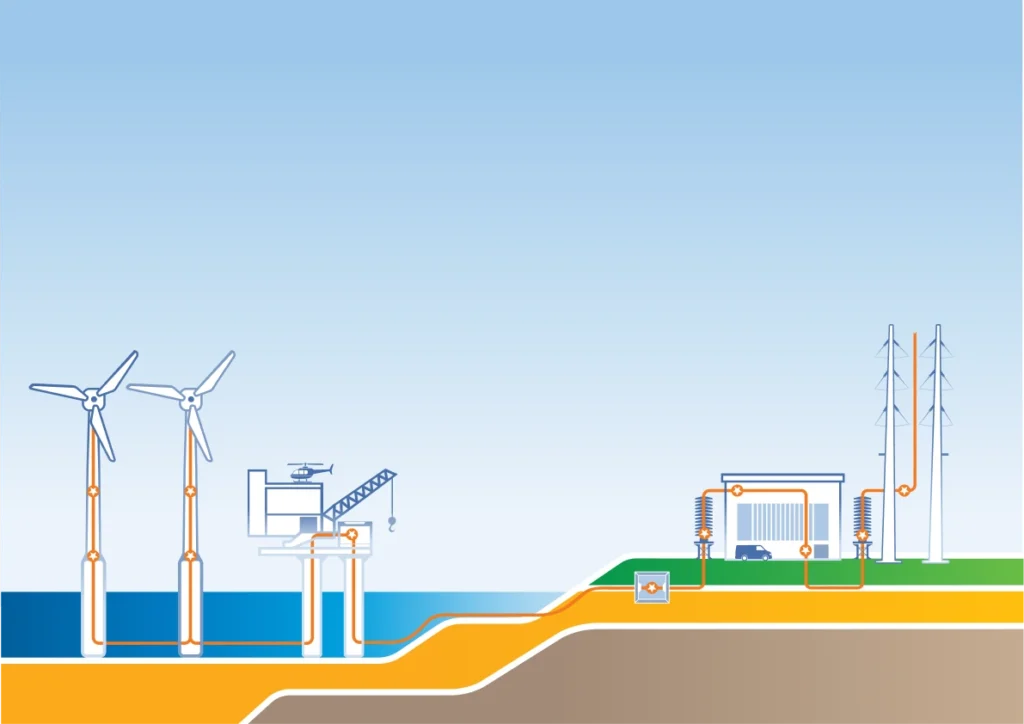
- Onshore Back-Feed & Switching (Days 3–5): Next, operators back-feed voltage from the onshore national grid out to the offshore substation. High-voltage circuit breakers execute automated switching sequences. This action energises the export cable, main offshore step-up transformers, and busbars.
- The 24-to-48-Hour “Soak Test”: Finally, operators hold the newly energised export system continuously under full operational voltage at zero load. This critical “soak test” proves the thermal and dielectric stability of the entire cable circuit before active generators connect.
3. From Cable to Customer: Where Does the Offshore Power Go?
After the offshore substation and inter-array cable strings are energised, technicians commission individual wind turbine generators. They synchronise each turbine to the grid one by one over subsequent weeks.
As wind power enters the high-voltage transmission grid, it fuels every facet of modern society:
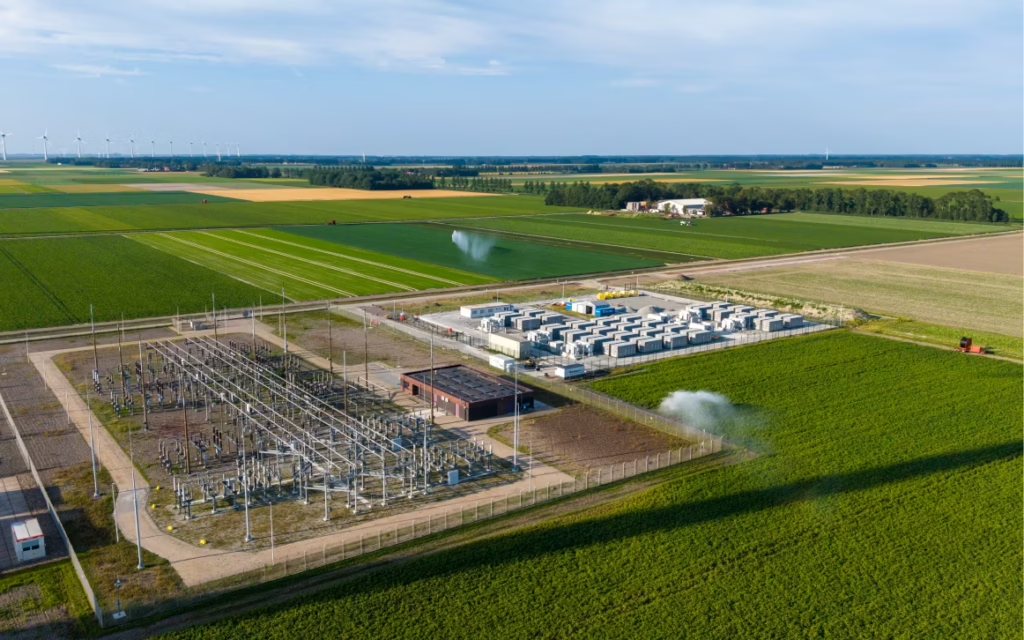
- Heavy Industry & Coastal Manufacturing: Electricity follows the physical path of least resistance. Therefore, energy-intensive industrial hubs near port cities—such as steel mills and chemical plants—consume much of this local offshore power.
- Hyperscale Data Centres: Cloud infrastructure and AI processing demand uninterrupted, high-density power. As a result, clean offshore wind provides the ideal backbone for sustainable compute capacity.
- EV Mobility & Transport Networks: Fast-charging hubs along major transport corridors draw directly from the grid to power thousands of electric vehicles simultaneously.
- Smart Homes & Communities: In addition, residential neighbourhoods benefit directly through cleaner heating, cooling, and domestic power.
4. The “Power Pool”: How Offshore Wind Guarantees Zero Carbon
People often ask: How do we know a specific facility or EV actually runs on offshore wind?
Think of the national power grid as a giant swimming pool. Offshore wind parks act as high-volume pumps filling the reservoir with clean water. Meanwhile, factories, data centres, and homes draw water out. You cannot colour-code individual electrons once they mix in the transmission network. Nevertheless, every megawatt-hour produced offshore instantly displaces fossil-fueled generation elsewhere on the grid.
To contractually link consumption to production, commercial consumers utilize Guarantees of Origin (GOs) or sign direct Corporate Power Purchase Agreements (PPAs). As a result, every kilowatt-hour consumed by a facility or vehicle matches 1:1 with offshore wind generation.
Empowering the Energy Transition
At Reynard High Voltage Solutions, we deliver end-to-end expertise in HV cable termination, testing, and commissioning. We ensure seamless offshore wind energisation and grid connections, turning years of capital investment into reliable, zero-emission power.